R.E
Intent
Vision
Our curriculum at Broughton Primary School encompasses the aims set out below to meet the needs of our children. The Religious Education curriculum provides the vehicle to bring these aims to life:
Aims of our curriculum
- ENGAGE - Pro-actively engage children in their education and help them to be responsible for their successes and achievements both academically and socially
At Broughton Primary School, we follow the ‘Living Difference’ Syllabus. It is a prescriptive and systematic pedagogical framework. It gives a process for teaching and learning and a conceptual analysis of religious material. The children are given many opportunities throughout their schooling to delve deep into concepts from many faiths and cultures and reflect on their own lives. We believe children should be active in their learning and we therefore ensure a range of teaching strategies to develop and embed conceptual understanding.
- EVALUATE - They will have the ability to evaluate the choices they can make and make conscious decisions based on these evaluations
Within the living difference framework, there is opportunity to ‘communicate’, in which children are invited to share their experiences in different ways. Children are encouraged to analyse and compare their own lives, traditions, routines and rituals with other religious faiths. Through their learning, children are given the time to think, reflect, debate, and discuss their thoughts and opinions.
- EMPOWER - The children will feel empowered and unafraid of challenge or initial failure
Children learn to have a desire to embrace challenging activities, including opportunities to undertake high-quality research across a wide range of cultural topics. They will feel empowered by their knowledge of a wide variety of concepts, enabling them to define who they are and to value the differences and similarities between themselves and others. We endeavour to provide opportunities to celebrate diversity, inclusion and equality within our school community.
- REPONSIBLE - The children will have a developed sense of shared responsibility for things outside their immediate person.
We want all our children to be able to thrive as responsible, fully equipped British citizens who understand British values. This will mature their ability to be reflective about their own and those of others. We are a rights respecting school that promotes these values accompanied by a robust religious education will have our children ready and responsible to participate constructively in the communities where they will live as adults.
- ENJOYMENT- The children will love/ look forward to coming to school (the majority of the time!)
Using the Living Difference syllabus, we plan an interactive and engaging series of lessons, which maximise opportunities for children to learn in real life contexts. We plan school visits that mean something to the children to provide them with experiences that enhance deeper learning. We have good connections to our local church, having whole school visits twice a year. We use interesting and relevant resources to inspire and engage children in current concepts and ask thought-provoking, open-ended questions.
Implementation
Teachers plan from the Living Difference Syllabus, alongside progression of skills to ensure appropriate coverage of knowledge and skills throughout the year groups. This progressive, cyclical learning approach deepens the children’s understanding each time. It also ensures good coverage of the many concepts covered throughout their time at Broughton.
We have completed an audit of our Religious Education curriculum and mapped out the progression through each class to ensure children revisit and build on prior learning throughout their time at Broughton. Within RE, there are many cross-curricular links such as to Rights Respecting Education, Spiritual, Moral, Social and Culture development (SMSC), and Personal, Social, Health and Economic education (PSHE).
Impact
By the time children leave Broughton Primary School at the end of Year 6, they are equipped with:
- An excellent knowledge and understanding of a variety of religions and cultures.
- An understanding of British Values and the society we live in.
- The ability to think broadly about religion and communicate ideas and talk confidently about their own life and the way they live.
- A developing sense of curiosity and feeling inquisitive about the world around them with an understanding that how people live can be both similar and different at the same time.
- Knowing who they are and holding good morals for life.
Interfaith Week 2024
"Spirituality"
During Interfaith Week 2024 we have been learning about spirituality. Spirituality exists amongst all faiths and within every person. We have been looking at what this means to us and the different ways that we can identify and experience spirituality in school and in our lives. Spirituality isn't just about religious belief—it's about connecting with something outside of yourself that brings meaning and connection to your life. The children will use the symbols of the mirror, window, door and candle to talk and share ideas:
- Mirror: Self - (being a unique person and understanding self-perception)
- Door: Others - (how empathy, concern, compassion and other values and principles affect relationships)
- Window: World and Beauty - (perceiving and relating to the physical and creative world through responses to nature and art)
- Candle: Beyond – (relating to the transcendental and understanding experiences and meaning outside the ‘everyday’)
Article 14: The UNCRC says that children and young people are free to be of any or no religion.
Article 15: Recognising that all children and young people have the human right to freedom of association.
Article 30: Children and young people who belong to a minority group have the right to share their culture, language and religion with other people in that group.
We have focussed on “The Mirror Moments” during this week.
Our Spirituality Art Exhibition - Inspired by Romerro Britto


Interfaith Week Nov 2023
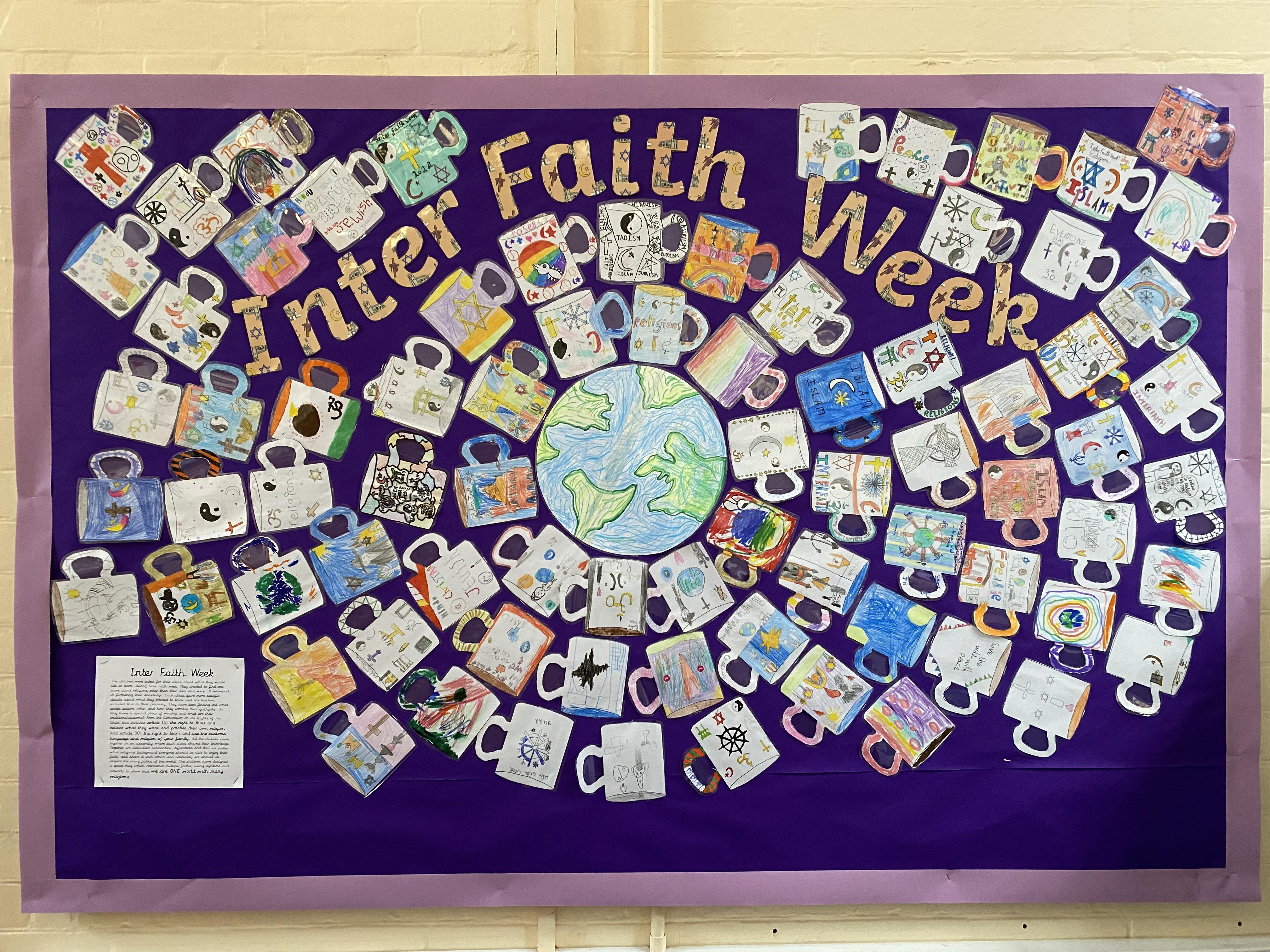
The aim of Inter Faith Week was to strengthen and increase the children’s awareness of the different and distinct faith communities in the UK, in particular, celebrating diversity and commonality.
We also wanted to build connections with people within our community. Our focus this year was the ritual of prayer and each class delved a little deeper into a particular faith. At the end of the week, each class shared their work with the rest of the school.
We invited Georgie Bateman from the Christian community and she spoke passionately to the children about her relationship with God and translated the Lord’s Prayer.
Mr Hosny and Dr Salter spoke enthusiastically to the children about their Islamic faith. They bought some very special items and allowed the children to participate by having a hands-on experience and exploring the copies of the Quran.
Mr Fogel shared his experience and expertise on what it is like to live within the Jewish faith. He also shared interesting items that were precious and symbolised his community. The children were thrilled to try on the kippar and to learn songs in Hebrew.
Having people from our community come in to visit the children has enabled real learning and has deepened the understanding of real-life people and their beliefs. Their knowledge of multiple faiths has broadened and has taught the children to respect other people’s beliefs, faiths and communities. All the work from Inter Faith Week will be displayed in the main school when it has been collated. A huge thank you to our wonderful visitors and the class teachers for their support and enthusiasm during this fantastic week.


